


AI Is Not Failing Because the Technology Is Weak. It Is Failing Because Organizations Are Missing a Process.

By Paul Ayres
THEFITPROFESSIONAL1
Executive Summary
Artificial intelligence is rapidly becoming one of the largest corporate investments in modern business history. Organizations across nearly every industry are investing aggressively in automation, predictive analytics, workflow acceleration, communication systems, customer response capabilities, and operational support tools that promise to redefine productivity and competitive advantage. Yet despite the enormous enthusiasm surrounding these investments, the overwhelming majority of organizations are still struggling to achieve meaningful operational value at scale. The technology itself continues to improve at a remarkable speed, but implementation success remains inconsistent, fragmented, and in many cases disappointing.
Recent research published by Harvard Business Review, along with supporting work from McKinsey, MIT Sloan Management Review, and Boston Consulting Group, points toward a remarkably consistent conclusion. AI initiatives are not primarily failing because the technology lacks capability. They are failing because organizations lack a disciplined implementation framework capable of translating executive ambition into operational execution. The breakdown occurs most often between leadership vision and day-to-day operational reality, precisely where workflows, staffing pressures, communication systems, accountability structures, and practical execution challenges intersect.
This is where my Strategic Initiative Process, or SIP for short, becomes potentially extraordinarily valuable.
SIP was never intended to function merely as another technology implementation model. It was designed as a strategic execution framework capable of helping organizations define, analyze, communicate, prioritize, structure, quantify, fund, implement, and sustain meaningful organizational initiatives under real operating conditions. AI initiatives simply happen to expose, with unusual clarity, the exact organizational weaknesses SIP was designed to address. The SIP process forces organizations to clarify destination states, evaluate workflow implications, identify assumptions, analyze risks, establish measurable outcomes, create accountability systems, define milestones, and build upward and downward communication loops that allow implementation intelligence to move throughout the organization.
Perhaps most importantly, SIP is highly trainable and operationally scalable. It supports both executive alignment and bottom-up participation, allowing organizations to capture the operational intelligence of the people closest to the work while still maintaining strategic consistency and financial discipline. That capability may ultimately become one of the defining differences between organizations that merely invest in AI and organizations that successfully operationalize it.
The companies that ultimately win in artificial intelligence will likely not be the ones issuing the boldest press releases or spending the largest amounts of capital. They will be the organizations capable of turning strategic ambition into disciplined operational execution. Increasingly, that appears to be the real competitive advantage.
There is an increasingly important realization beginning to emerge within executive leadership discussions surrounding artificial intelligence, and it may ultimately reshape how organizations think about transformation itself.

The primary obstacle preventing companies from achieving meaningful returns on AI investment may not be the technology. In many cases, the real problem appears to be organizational execution.
That distinction matters enormously because it changes the entire nature of the conversation. The issue is no longer simply whether organizations should invest in AI or whether the technology itself possesses enough long-term potential to justify aggressive adoption. Most executive teams have already answered those questions. The more difficult and far more consequential question is whether organizations possess the internal leadership discipline, operational alignment, communication systems, workflow clarity, and implementation capability necessary to successfully integrate these initiatives into the realities of everyday business operations.
Those are very different challenges.
A recent Harvard Business Review article titled Managers and Executives Disagree on AI—and It’s Costing Companies highlighted this issue with unusual clarity.
Drawing on research conducted through the Wharton School and GBK Collective Enterprise AI Adoption Study, the article points toward a troubling but increasingly visible pattern throughout large organizations. Companies are investing heavily in AI initiatives, and executive optimism remains exceptionally high, yet very few organizations are producing enterprise-wide operational value proportional to the scale of investment being made. The article references converging research from BCG, McKinsey, and MIT, indicating that fewer than 10 percent of companies are capturing meaningful AI value at scale. That statistic alone should immediately shift the discussion from technological enthusiasm toward implementation discipline.

What makes the article particularly valuable is that it identifies where much of the breakdown is actually occurring.
The authors describe what they call the “messy middle,” the operational space between executive leadership and middle management, where strategic initiatives either become operational reality or collapse under the weight of workflow friction, unclear priorities, overloaded systems, and fragmented communication.
Senior executives often view AI through the lens of strategic leverage, long-term competitive positioning, investor expectations, and future capability. Middle managers, however, experience these same initiatives through the realities of staffing limitations, inconsistent workflows, operational deadlines, reporting responsibilities, customer demands, training burdens, and accountability pressures that already exist before a new initiative is introduced.
In many ways, both groups are evaluating the same initiative accurately, but from entirely different operating environments.

Executives frequently see possibilities because their interaction with AI tends to occur at the level of synthesis, strategic modeling, drafting, analytics, and high-level decision support, where the technology already performs reasonably well. Middle managers, on the other hand, are responsible for integrating these systems into operational environments where processes have evolved over the years, where errors carry real consequences, where workflow disruptions affect customers and employees immediately, and where implementation failure becomes visible long before strategic success ever materializes. The result is that executive leadership often experiences AI as acceleration while operational leadership experiences it as disruption requiring containment, coordination, adaptation, and risk management.
This disconnect is not a minor communication issue. It is a structural execution problem.
The reason these matters so much is because history consistently demonstrates that
organizations rarely fail from lack of strategic ambition alone. Most organizations fail because they underestimate the complexity of implementation. Technology itself is often the easiest part of transformation. Aligning people, workflows, measurements, communication systems, accountability structures, priorities, training requirements, and operational realities is substantially harder. Unfortunately, many organizations still approach transformation initiatives as if announcing a strategy and funding a technology platform are enough to create meaningful organizational change.
They are not.
This is precisely where SIP becomes extraordinarily relevant because the Strategic Initiative Process was designed specifically to address the implementation gap between strategic vision and operational execution. SIP begins with a foundational assumption that many organizations still fail to fully appreciate: an initiative is not valuable simply because leadership believes it is strategically important. An initiative only becomes valuable when it can survive operational reality while producing measurable improvement that matters to the organization.
That single distinction changes the entire implementation discussion.
Rather than beginning with excitement surrounding the technology itself, SIP forces organizations to first clarify the operational purpose of the initiative:
What specifically is changing?
What measurable result improves?
Which workflows are affected?
What assumptions support the expected outcomes?
What operational risks are introduced?
What communication systems are required?
What milestones determine progress?
What training burdens will emerge?
How will success actually be measured?
What operational resistance should reasonably be expected?
What strategic objective does the initiative support, and how does leadership know the initiative is aligned with the organization’s intended destination state?
(I use ‘destination state’ in place of vision. Vision and mission are confusing. The destination state defines specifically where measures, assets, people, etc., are at when the intended future is a reality. People can follow this and decide effectively along the road there).
Research Corner
Research from Gallup, McKinsey, and MIT has consistently demonstrated that organizations generating strong employee involvement in operational improvement initiatives tend to outperform peers in productivity, retention, adaptability, and profitability.

Multiple studies cited by McKinsey and Harvard Business Review have also shown that companies effectively integrating workforce participation into transformation initiatives achieve substantially higher implementation success rates than organizations relying primarily on top-down deployment models.
These are not administrative exercises designed to slow innovation. They are execution disciplines designed to protect it.
One of the most common weaknesses in current AI initiatives is that organizations are attempting to deploy technology before they fully understand the workflows they are trying to improve. In many cases, companies are automating fragmented processes, inconsistent communication systems, unclear accountability structures, and operational inefficiencies that already existed before AI was introduced. When that happens, organizations do not eliminate dysfunction. They accelerate it. AI can dramatically improve strong systems, but it can also magnify confusion, poor process design, weak communication, and inconsistent operational execution if those problems are left unresolved beforehand.
This is why SIP intentionally forces organizations to analyze workflow first before large-scale implementation occurs. That distinction alone separates SIP from many current transformation models that begin with technology selection rather than operational design. SIP positions technology as a tool operating within the larger business process rather than allowing the technology itself to become the process. That difference may ultimately determine whether organizations generate sustainable operational improvement or simply produce expensive organizational disruption disguised as innovation.

If you want to know more about SIP, let me know on my website www.thefitprofessional1.com. You can also check out the case study to get more summary information on how SIP might be applied to an AI project. Please also keep an eye out in this newsletter and on my website this summer for more newsletters regarding SIP, classes, tools, and more! Go make it a great day!
Professional Bibliography
Ayres, Paul. Funding Your Future: Beyond Banks – Creative Alternatives to Funding Your Startup or Business Initiative. THEFITPROFESSIONAL1 Publishing, 2025
Ayres, Paul. “How to Get Your Ideas Approved and Funded.” AEC Tech Con Presentation Materials, 2026.
Ayres, Paul. Strategic Initiative Process (SIP) Framework and Organizational Implementation Materials. THEFITPROFESSIONAL1, LLC, 2025–2026.
Christensen, Clayton M. The Innovator’s Dilemma. Harvard Business Review Press, 1997.
Deming, W. Edwards. Out of the Crisis. MIT Press, 1986.
Drucker, Peter F. Management: Tasks, Responsibilities, Practices. Harper & Row, 1973.
Kaplan, Robert S., and David P. Norton. The Balanced Scorecard: Translating Strategy into Action. Harvard Business School Press, 1996.
Korst, Jeremy, Stefano Puntoni, and Prasanna Tambe. “Managers and Executives Disagree on AI—and It’s Costing Companies.” Harvard Business Review, April 8, 2026, pp. 1–9.
McKinsey & Company. “The State of AI: How Organizations Are Rewiring to Capture Value.” McKinsey Global Survey, 2025.
MIT Sloan Management Review. “The Cultural Benefits of Artificial Intelligence in the Enterprise.” MIT Sloan Management Review, 2024.
Porter, Michael E. Competitive Advantage: Creating and Sustaining Superior Performance. Free Press, 1985.
Shapiro, Benson P. “What the Hell Is Market Oriented?” Harvard Business Review, November–December 1988.
Sinek, Simon. Start With Why. Portfolio, 2009.
Thull, Jeff. Mastering the Complex Sale. Wiley, 2010.
BCG Henderson Institute. “AI at Work: Leadership, Culture, and Organizational Readiness.” Boston Consulting Group, 2025.
Gallup. State of the Global Workplace Report, 2025.
Mintzberg, Henry. The Rise and Fall of Strategic Planning. Free Press, 1994.
Appendix:
Research Corner & Case Study
What AI Implementation Looks Like When SIP Is Applied Correctly

One of the most important questions organizations should be asking right now is not whether artificial intelligence can improve performance. In many environments, that answer is already becoming increasingly obvious. The far more important question is whether organizations possess a disciplined implementation process capable of converting AI capability into sustainable operational value.
This is precisely where the Strategic Initiative Process becomes exceptionally powerful because SIP forces organizations to slow down just enough to think clearly before accelerating aggressively. That distinction matters enormously in AI implementation efforts because many companies are currently introducing AI tools into operational systems that were never fully understood, standardized, measured, or aligned to begin with. In those environments, artificial intelligence often amplifies inconsistency rather than eliminating it.
To better understand how SIP operates in practice, it is useful to walk through a realistic AI implementation example. The following case study is a created example based on common implementation conditions repeatedly discussed throughout Harvard Business Review, MIT Sloan Management Review, McKinsey, Boston Consulting Group, and operational leadership research regarding AI transformation efforts. While fictionalized for illustration purposes, the operational conditions, organizational tensions, workflow problems, and implementation barriers reflect very real patterns emerging across industries today. We are also not going to follow the detailed SIP steps verbatim, but rather speculate on the impact of them being done correctly. For more, you can contact me anytime.
The diagram here is the process at a glance, used in this case:

Imagine a mid-sized heavy civil construction company operating across several states with approximately 450 employees and an annual revenue of $180 million. The organization decides to pursue an AI initiative focused on project management and operational reporting. Executive leadership believes AI can reduce administrative workload, improve schedule communication, accelerate reporting cycles, assist with forecasting, reduce project documentation time, and improve field-to-office communication. The vision itself is reasonable and strategically aligned with the company’s long-term objectives surrounding scalability, margin protection, and operational consistency.
Without SIP, many organizations would immediately begin vendor discussions, purchase software, assign implementation deadlines, and instruct managers to begin utilizing the system. In many cases, this is exactly where the failure sequence quietly begins because the organization has not yet clarified the operational realities surrounding the initiative itself.
SIP approaches the implementation entirely differently.
The first step is defining the initiative in operational language rather than technological language.
Instead of beginning with “we are implementing AI,” SIP forces leadership to define the actual business problem being solved. The organization must articulate precisely what operational friction currently exists and what measurable improvement the initiative is expected to produce.
In this example, leadership may determine that project managers are spending nearly 35 percent of their time performing administrative communication tasks, including status updates, documentation preparation, meeting summaries, schedule reporting, subcontractor communication coordination, and repetitive client reporting requirements.
That definition matters because the initiative is no longer centered around technology enthusiasm. It is now centered around workflow improvement tied to measurable operational constraints.
SIP then forces leadership to connect the initiative directly to the company’s destination state and strategic priorities. Why does reducing administrative burden matter strategically? Leadership may determine that the company’s long-term strategy requires scaling annual revenue without proportionally increasing administrative overhead. They may further conclude that improving project communication consistency reduces risk exposure, improves customer confidence, enhances schedule reliability, and allows project managers to spend more time on active operational leadership rather than documentation processing.
This alignment process is extraordinarily important because many AI initiatives fail precisely because employees cannot see how the initiative connects to meaningful organizational goals. SIP eliminates that ambiguity early.
The next SIP phase examines workflow realities before implementation begins.
This is one of the areas where SIP differs substantially from many current AI deployment approaches. Rather than assuming the technology itself will solve operational problems automatically, SIP requires the organization to map the existing workflow in detail.
How are reports currently generated?
Where does project data originate?
Which systems contain the necessary information?
How consistent are reporting formats between divisions?
Where do delays currently occur?
What information requires human verification?
Which communication systems are standardized, and which are highly individualized between project managers?
What organizations frequently discover during this phase is that the workflow itself often contains substantial inconsistency before AI is ever introduced. Different project managers may use entirely different documentation approaches. Reporting standards may vary between divisions. Information may exist in disconnected systems. Field supervisors may communicate differently depending on experience, technical comfort, or personality style. Some reporting structures may rely heavily on tribal knowledge that has never been formally documented.
This discovery phase is critically important because artificial intelligence performs best when operating inside reasonably disciplined process environments. Attempting to automate fragmented or inconsistent workflows frequently produces unreliable outcomes and organizational frustration.
Research increasingly supports this conclusion: MIT Sloan Management Review has repeatedly emphasized that successful digital transformation depends heavily on process redesign, operational clarity, leadership alignment, and organizational readiness rather than technology deployment alone. McKinsey research has similarly shown that organizations generating the strongest AI results are typically those that redesign workflows and operating models alongside technology implementation rather than layering AI onto unstable operational systems.
After workflow analysis, SIP forces assumption identification and risk analysis before implementation proceeds further. This is another area where many organizations unintentionally create avoidable failure because they often implement AI systems based on optimistic assumptions that remain largely untested. SIP requires these assumptions to be surfaced openly.
Leadership may initially assume that project managers will enthusiastically adopt the new system because it reduces reporting workload. However, middle managers may express concern that AI-generated reports could introduce factual errors requiring additional review time. Field supervisors may worry that communication becomes less personal and more standardized in ways that reduce trust with crews or subcontractors. IT personnel may identify integration concerns between legacy systems and AI reporting platforms. Project executives may worry about legal exposure surrounding inaccurate documentation or automated communication errors.
Rather than treating these concerns as resistance, SIP treats them as operational intelligence.
That distinction changes the organizational dynamic dramatically because employees closest to the work begin participating in implementation refinement rather than simply absorbing executive directives. The Harvard Business Review article discussed this issue directly when emphasizing the importance of “co-creating the playbook” rather than handing implementation down from above. SIP operationalizes exactly that principle.
Once assumptions and risks are clarified, SIP moves into structured pilot implementation rather than broad organizational rollout. This sequencing is extremely important because one of the most common AI implementation mistakes occurring today is premature enterprise-wide deployment before workflows, measurements, training systems, and operational standards have stabilized.
In this example, the company may select two project teams with different operational characteristics for pilot testing. One team may involve a highly experienced project manager already comfortable with technology integration, while another team may involve a more traditional operational environment where adoption resistance is more likely. SIP intentionally values this contrast because implementation systems must survive operational diversity, not merely ideal conditions.
The pilot phase would establish measurable success metrics before testing begins. Administrative reporting time reduction may be tracked weekly. Schedule communication accuracy may be measured. Error correction frequency may be documented. Employee workload perception may be evaluated. Customer communication response times may be monitored. Project manager capacity utilization may be analyzed. Operational stress indicators may even be discussed during review meetings.
This is another area where SIP provides major advantages because many organizations currently measure AI implementation primarily through usage rates rather than operational readiness and measurable business outcomes. Simply proving employees logged into a system does not prove operational value was created.
The Harvard Business Review article warned about this exact issue when discussing the importance of measuring readiness rather than adoption alone. SIP naturally supports this philosophy because the process was designed around measurable initiative value rather than technology enthusiasm.
Equally important, SIP establishes upward and downward communication loops throughout implementation. Project managers participating in the pilot are expected to report implementation friction honestly. Workflow interruptions, inaccurate outputs, communication problems, customer reactions, reporting inconsistencies, and operational burdens are surfaced intentionally during review cycles. Leadership is then expected to respond visibly and constructively.
This is critically important because many AI initiatives fail quietly long before they fail publicly. Employees often recognize workflow problems early but conclude leadership is more interested in maintaining transformation momentum than hearing operational truth. Once employees stop providing honest implementation feedback, organizational learning deteriorates rapidly.
SIP intentionally combats this tendency by institutionalizing operational feedback as a required implementation discipline rather than treating it as optional commentary.
Another important strength within SIP is its ability to integrate financial analysis directly into operational implementation.
Throughout the pilot process, measurable operational outcomes are connected to economic value. Administrative workload reduction is translated into capacity improvement. Reporting acceleration is connected to decision-making speed. Error reduction is connected to risk exposure. Improved communication consistency is tied to customer confidence and project predictability.
This prevents AI initiatives from remaining abstract strategic concepts disconnected from measurable business performance.
Suppose the pilot eventually demonstrates that project managers reduced administrative reporting time by 18 percent while maintaining or improving reporting accuracy. Suppose communication response times improved significantly and customer satisfaction scores increased modestly because reporting became timelier and more consistent. Suppose further analysis showed project managers were spending more time actively leading field operations rather than preparing repetitive documentation.
At this point, the organization possesses something substantially more valuable than executive optimism. It possesses operational evidence. That distinction matters enormously because organizations build sustainable transformation cultures when employees see initiatives producing measurable operational improvement rather than merely generating executive enthusiasm.
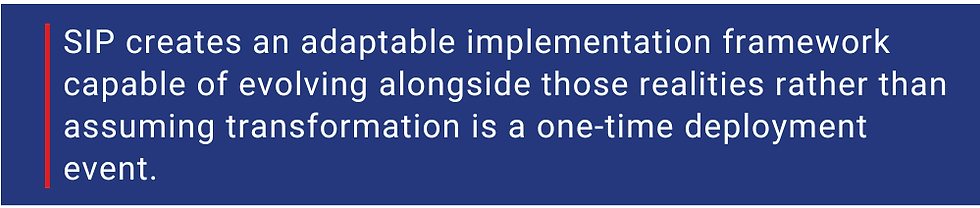
Importantly, SIP also recognizes that implementation success does not eliminate the need for continued refinement. Even after the broader rollout begins, SIP maintains milestone reviews, measurement analysis, workflow evaluation, communication assessments, and risk monitoring processes designed to continuously improve implementation quality. AI systems, workflows, leadership behaviors, staffing capabilities, and communication structures continue evolving together rather than being treated as separate organizational functions. This may ultimately become one of SIP’s most important advantages in AI transformation efforts.
Artificial intelligence is not static technology. It evolves rapidly. Organizational workflows also evolve continuously. Leadership structures shift. Staffing changes. Operational priorities change. Customer expectations change.
The broader implication here is extremely important. The future winners in AI implementation will likely not be the organizations that simply purchase the most advanced systems. They will be the organizations capable of integrating those systems into disciplined operational environments supported by communication clarity, workflow understanding, measurable accountability, financial analysis, leadership alignment, and continuous organizational learning.
That is exactly the environment SIP was designed to create.
Standalone Research Bibliography
SIP, AI Transformation, Workflow Integration, and Organizational Execution
Ayres, Paul. Funding Your Future: Beyond Banks – Creative Alternatives to Funding Your Startup or Business Initiative. THEFITPROFESSIONAL1 Publishing, 2025.
Ayres, Paul. Strategic Initiative Process (SIP) Framework and Organizational Implementation Materials. THEFITPROFESSIONAL1, LLC, 2025–2026.
Brynjolfsson, Erik, and Andrew McAfee. The Second Machine Age: Work, Progress, and Prosperity in a Time of Brilliant Technologies. W.W. Norton & Company, 2014.
Christensen, Clayton M. The Innovator’s Dilemma. Harvard Business Review Press, 1997.
Deming, W. Edwards. Out of the Crisis. MIT Press, 1986.
Drucker, Peter F. Management: Tasks, Responsibilities, Practices. Harper & Row, 1973.
Gallup. State of the Global Workplace Report, 2025.
Kaplan, Robert S., and David P. Norton. The Balanced Scorecard: Translating Strategy into Action. Harvard Business School Press, 1996.
Korst, Jeremy; Puntoni, Stefano; Tambe, Prasanna. “Managers and Executives Disagree on AI—and It’s Costing Companies.” Harvard Business Review, April 8, 2026, pp. 1–9.
McKinsey & Company. “The State of AI: How Organizations Are Rewiring to Capture Value.” McKinsey Global Survey, 2025.
Mintzberg, Henry. The Rise and Fall of Strategic Planning. Free Press, 1994.
MIT Sloan Management Review. “The Cultural Benefits of Artificial Intelligence in the Enterprise.” MIT Sloan Management Review, 2024.
Porter, Michael E. Competitive Advantage: Creating and Sustaining Superior Performance. Free Press, 1985.
Schein, Edgar H. Organizational Culture and Leadership. Wiley, 2016.
Shapiro, Benson P. “What the Hell Is Market Oriented?” Harvard Business Review, November–December 1988.
Sinek, Simon. Start With Why. Portfolio, 2009.
Thull, Jeff. Mastering the Complex Sale. Wiley, 2010.
Boston Consulting Group Henderson Institute. “AI at Work: Leadership, Culture, and Organizational Readiness.” Boston Consulting Group, 2025.


Comments