


ARE WE DEVELOPING CAREERS OR COLLECTING EMPLOYERS?

by Paul Ayres
Executive Summary
Do you know what today's job seekers ask about first? Not the work. The schedule. The commute. The flexibility. Somewhere in the last several years, the order changed, and I don't think most of us noticed it happen.
Every generation believes the workforce is changing, and every generation is usually right. Technology evolves. Industries rise and fall. Organizations restructure. Economic conditions force employers and employees alike to rethink their priorities. The past several years have been no exception. Artificial intelligence, remote work, organizational downsizing, economic uncertainty, and changing employee expectations have combined to reshape the employment landscape faster than most organizations have experienced in decades.
Recently, I sat with a young professional who had been displaced during a corporate downsizing. She was preparing for an important interview, and as we talked, I was surprised how quickly the conversation turned to a long list of personal requirements that had to be satisfied before we even discussed the work itself. Schedule flexibility. Personal routines. Commuting expectations. Work environment. A handful of other lifestyle factors, already nonnegotiable. Only after we worked through all of that did we get to the actual job: the responsibilities, the opportunity to learn, the skills she might develop, how the role could shape a long and successful career.
That conversation stayed with me, because it raised a question bigger than one interview. Has the mindset of today's job seeker fundamentally changed? Have we quietly shifted from asking, “What opportunity will help me become an exceptionally capable professional?” to asking, “What opportunity best protects the life I have already built?” And if that shift is real, what does it mean, not only for employers, but for the long-term development of the professionals making those decisions?
I began researching that question expecting to confirm what I suspected, that career ambition had simply declined. Instead, the research told a far more interesting story. Studies from organizations including Gallup, Deloitte, and other respected institutions consistently show that today's professionals continue to value learning, growth, meaningful work, and opportunities to develop new skills. Ambition has not disappeared. Rather, the sequence of decision-making appears to have changed. Increasingly, professionals first evaluate whether a position fits within a carefully protected set of personal constraints. Only after those conditions are satisfied does the discussion turn toward professional growth and long-term capability.
That distinction might sound subtle. It isn't. Throughout history, the experiences that produced exceptional professionals were rarely the easiest or the most comfortable. They demanded greater responsibility, required difficult decisions, exposed weaknesses, expanded technical expertise, and forced people to develop judgment through experience. Those opportunities often involved temporary inconvenience, uncertainty, or sacrifice. Yet they were also the experiences that transformed capable employees into trusted leaders and recognized experts.
Let me be clear about what this article is not. It is not an argument against work-life balance, flexibility, family commitments, or personal well-being. Those priorities matter, and the research makes clear that they should. This is an invitation to reconsider the order in which we make career decisions. If we consistently reject opportunities because they disrupt today's preferences, we may also be rejecting the very experiences that would have produced tomorrow's capabilities.
Over the following pages, we will examine what recent research reveals about the changing priorities of today's workforce, how employers are responding, and why the pursuit of professional mastery deserves renewed attention. Along the way, I will also offer my own perspective after more than four decades of leading organizations, developing people, and observing thousands of careers unfold. My hope is not to persuade anyone to sacrifice the life that matters most to them, but to get every professional thinking hard about a question that may shape the rest of their working lives.
Are you intentionally building mastery? Or are you simply collecting employers?

The Question I Wasn't Expecting to Ask
There are moments in every professional career when a simple conversation stops you cold and makes you reconsider something you've taken for granted. This article began with one of those moments.
I was speaking with a young professional who had unexpectedly found herself looking for work after her employer reduced its workforce. Like so many talented people over the past several years, her job loss was not the result of poor performance or lack of effort. Organizations continue to restructure, technology continues to change the work itself, and economic conditions continue to force difficult decisions that affect good employees as much as struggling ones. She was preparing for what appeared to be an excellent opportunity, and naturally our conversation turned toward the upcoming interview.
I found myself waiting for the questions I have heard throughout most of my professional life. Would this role provide greater responsibility? Would it expose her to experienced leaders who could become mentors? Would it broaden her technical knowledge or business understanding? Would the organization provide opportunities to develop expertise that would still be valuable ten or twenty years from now? Could success in this position prepare her for progressively larger responsibilities throughout her career?
Those questions never came.
Instead, the conversation became centered on a series of personal requirements that had already been established before the opportunity itself could be evaluated. The work schedule needed to fit a particular routine. The commute had to remain within an acceptable range. Certain working arrangements were immediately ruled out. Specific expectations about flexibility, personal time, and lifestyle had become fixed boundaries. Only if those requirements could be satisfied would the actual work become part of the discussion.
There was nothing unreasonable about any individual requirement. In fact, viewed independently, each one made perfect sense. Every professional has legitimate responsibilities outside the workplace. Families matter. Health matters. Personal relationships matter. None of us should pretend otherwise, nor should employers ignore those realities. The issue was not the existence of personal priorities. The issue was the sequence in which the decision was being made.
That distinction stayed with me long after our conversation ended. It forced me to ask a question I had never seriously considered during more than forty years of building organizations, leading teams, hiring employees, and mentoring professionals at every stage of their careers. Have we fundamentally changed the way we evaluate employment opportunities? Have we quietly moved from asking, “What opportunity will help me become exceptionally capable?” to asking, “What opportunity best protects the life I already have?”
At first, I suspected I had simply encountered an isolated example. After all, one conversation does not establish a trend, and every generation tends to believe the next approaches work differently. It would have been easy to dismiss the experience as anecdotal and move on. Yet the more I reflected on it, the more I began recognizing similar comments from other conversations over the past several years. I had heard people speak enthusiastically about remote work before discussing the work itself. I had listened to professionals evaluate organizations based on flexibility before asking about the complexity of the problems they would solve. Perhaps most telling of all, I had heard more than one individual describe a prospective employer by saying, “It will look good on my résumé.”
That statement deserves more attention than it usually receives. On the surface, it sounds practical, even strategic. We all understand that experience with respected organizations can create future opportunities. Yet hidden within that seemingly harmless observation is another possibility. If the organization is primarily viewed as a credential to be collected rather than a place to build mastery, has the decision to eventually leave already been made before the first day of work? More importantly, what happens to professional development when an employer becomes another entry on a résumé rather than the environment in which deep expertise is cultivated?

Those questions became the starting point for this research.
I did not begin this project hoping to prove that younger professionals care less about their careers. In fact, I hoped the evidence would challenge my initial assumptions. Experience has taught me that organizational problems are rarely explained by simple answers, and the most interesting discoveries often emerge when our own beliefs are tested rather than confirmed. Instead of looking for evidence that supported my observations, I intentionally sought research from respected business schools, consulting firms, workforce analysts, government labor data, and organizational psychologists whose conclusions might prove me wrong.
What I found surprised me.
The research consistently demonstrated that today's professionals continue to value meaningful work, learning, mentoring, and personal growth. In many respects, they are just as ambitious as previous generations, although they often define success differently. At the same time, the evidence also suggests that personal constraints have become far more influential in the employment decision than they once were. Career development has not disappeared, but it increasingly competes with a broader collection of personal priorities that many professionals now consider nonnegotiable.
That realization changed the purpose of this article.
This is no longer an attempt to criticize a generation, defend an employer's perspective, or argue that people should sacrifice their personal lives for their careers. The research simply does not support those conclusions. Instead, it points toward a far more important question, one that every professional should ask regardless of age, industry, or career stage.
If our first responsibility is to build the capabilities that will sustain us for decades, are we evaluating opportunities in the order most likely to achieve that objective? Or have we unintentionally allowed immediate comfort, however understandable, to become the filter that prevents us from recognizing the experiences that would ultimately make us far more valuable, more resilient, and more successful?
The remainder of this article is my attempt to answer that question as honestly as the evidence allows.
What the Research Actually Revealed
When I began researching this topic, I expected to find evidence supporting a relatively simple conclusion. I assumed I would discover that today's workforce had become significantly more focused on personal convenience and less interested in long-term professional development. Given the conversations I had been having, and the growing emphasis on flexibility and work-life balance in public discussions, that seemed like a reasonable expectation. It turned out to be only partially correct.
One of the disciplines I have learned over many years of solving organizational problems is that we must never become emotionally attached to our hypotheses. A hypothesis is simply our best explanation before sufficient evidence has been collected. If we insist that the evidence confirm our original thinking, we are no longer conducting research. We are simply looking for agreement. The organizations that consistently make the best decisions are those willing to modify their conclusions when the facts point them in a different direction.
That is exactly what happened here.
As I began reviewing research from Gallup, Deloitte, McKinsey, respected business schools, and workforce analysts, a much more sophisticated picture emerged. The data did not suggest that professionals had become less ambitious. It did not show that people no longer cared about meaningful work, learning new skills, or building successful careers. In fact, many of the studies reached almost the opposite conclusion. Younger professionals continue to place considerable value on learning, mentoring, acquiring new capabilities, and remaining employable in a rapidly changing economy. Concerns about artificial intelligence, automation, and the pace of technological change have actually increased awareness that continuous learning is becoming essential rather than optional.
If that had been the end of the story, there would have been little reason to continue this investigation. Yet another pattern began appearing with remarkable consistency.
Career development was still important, but it was rarely the first consideration.
Gallup's 2025 national research illustrates this shift particularly well. When employees were asked what mattered most when choosing a new position, the leading responses centered on personal well-being, compensation, stability, job security, and the opportunity to use their strengths. These are understandable priorities, especially after several years marked by inflation, organizational restructuring, layoffs, and uncertainty. What is noteworthy is not that these factors matter. They always have. What is noteworthy is the order in which they now appear. The first questions increasingly concern protecting personal circumstances. Questions regarding the developmental quality of the work often follow only after those initial concerns have been satisfied.
Deloitte's global workforce research paints a remarkably similar picture. Younger professionals consistently report that they want meaningful work, opportunities to learn, supportive leaders, flexibility, financial security, and organizations that invest in their growth. None of those aspirations suggest a lack of ambition. Rather, they suggest an attempt to combine professional development with a sustainable personal life. That is a very different conclusion than saying people simply want easier jobs.
This distinction became the turning point in my own thinking.
The issue is not whether professionals value career growth. Clearly they do. The issue is whether career growth has become conditional. Increasingly, opportunities appear to be evaluated through a series of personal filters before the developmental value of the work itself receives serious consideration. If the schedule, location, flexibility, commute, or other personal requirements do not align with existing preferences, many opportunities are eliminated before questions about long-term capability are ever asked.
That sequence matters because careers are cumulative. The professional you become twenty years from now is rarely determined by a single promotion or one extraordinary assignment. Instead, it is shaped by hundreds of decisions made over decades. Each assignment either expands your judgment or leaves it unchanged. Each responsibility either stretches your capabilities or reinforces what you already know. Each difficult problem either teaches you something new or passes to someone else. Professional mastery is built one opportunity at a time.
Throughout my career, I have had the privilege of working alongside individuals whose capabilities seemed almost extraordinary. They were not necessarily the smartest people in the room, nor were they always the most charismatic. What distinguished them was that they repeatedly accepted assignments others avoided. They volunteered to solve difficult operational problems. They accepted responsibility before they felt fully prepared. They worked through failures, corrected mistakes, and remained accountable for the long-term outcomes of their decisions. Looking back, I cannot remember a single one who would describe those experiences as convenient. Nearly all of them would describe them as transformational.
That observation is consistent with decades of research on expertise. Whether studying accomplished physicians, engineers, musicians, pilots, executives, scientists, or elite athletes, one principle appears repeatedly. Mastery develops through progressively more demanding experiences that require sustained effort, thoughtful reflection, and continual adaptation. Expertise is rarely produced by remaining comfortably within existing capabilities. It emerges because individuals repeatedly place themselves in situations that require them to become more capable than they were yesterday.
This realization also changed the question I believe every professional should ask when evaluating an opportunity. Instead of asking only, “Will this position fit my life today?” perhaps we should also ask, “Who will I become if I accept this position, and who might I never become if I decline it?”
That second question rarely appears in employment discussions today, yet it may be the one with the greatest long-term consequences.
None of this suggests that personal well-being should be ignored. Burnout serves no one. Family responsibilities deserve respect. Health, relationships, and personal commitments remain among life's highest priorities. The research rightly reminds us that successful careers should enhance our lives rather than consume them. At the same time, the research also challenges us to acknowledge a reality that is less frequently discussed. Every meaningful opportunity requires tradeoffs. Every significant promotion changes expectations. Every difficult assignment demands additional effort. Every period of accelerated growth temporarily disrupts our comfort.

The question, therefore, is not whether tradeoffs exist. The question is whether we are choosing tradeoffs that build a stronger future or simply preserve the present.
That is where this article ultimately leads. The evidence did not invalidate my original concern. It refined it. Today's professionals have not abandoned ambition. They have broadened the list of factors they consider before pursuing it.

The Five Personal Constraints That Now Shape Career Decisions
One of the first objectives of this research was deceptively simple. I wanted to identify the specific personal constraints that today's professionals most often seek to protect when evaluating a new opportunity. I deliberately avoided broad expressions such as work-life balance because they have become so common that they explain almost nothing. Nearly everyone wants balance. The more important question is, balance for what? What exactly are professionals trying to preserve before they agree to accept a new position?
As I reviewed the research, a pattern emerged with remarkable consistency. The specific wording differed from one study to another, but the underlying themes remained surprisingly stable. Whether the research originated from Gallup, Deloitte, LinkedIn, McKinsey, or workforce analysts studying labor trends, professionals repeatedly described five areas they were increasingly unwilling to compromise. Understanding those priorities is essential because they explain much of the decision-making taking place in today's labor market.
The first, and perhaps the most influential, constraint is control over one's time. This extends well beyond the traditional discussion of flexible schedules. Professionals increasingly seek the ability to decide when, and in many cases where, work is completed. They want greater influence over how their working hours fit with family responsibilities, personal interests, health, community involvement, and the countless obligations that exist outside the office. Time has become more than a scheduling issue. It has become a measure of personal autonomy. The research suggests that many employees now view the loss of that autonomy as a significant cost, even when accompanied by higher compensation or greater responsibility.
Closely related to that desire for autonomy is a second priority that can best be described as protecting personal well-being. This is another area where the conversation has evolved considerably over the past decade. Earlier generations often accepted that periods of exceptional professional growth would involve unusually demanding workloads. Today's workforce remains willing to work hard, but many professionals have become far more intentional about protecting their physical health, mental health, emotional resilience, and long-term sustainability. Given the disruption created by the pandemic, economic uncertainty, and increasing awareness of burnout, this change is understandable. It also reflects a broader cultural recognition that success achieved at the expense of personal health is rarely sustainable.
A third priority centers on financial security rather than simply compensation. At first glance, those concepts appear identical, yet the research consistently treats them differently. Competitive pay remains important, but many professionals are equally concerned about organizational stability, continued employment, predictable income, benefits, and confidence that the employer itself will remain healthy. Several years of layoffs across industries have understandably increased sensitivity to risk. Job seekers increasingly evaluate not only what an organization pays today, but also whether they believe that organization will provide stability tomorrow. In many respects, security has become part of the compensation package.
The fourth constraint involves preserving important personal relationships and responsibilities. Family obligations, caregiving, community involvement, and personal commitments now occupy a much more visible place in employment discussions than they once did. Organizations have gradually recognized that employees do not leave those responsibilities at the workplace entrance each morning, nor should they be expected to. Professionals increasingly seek careers that allow them to fulfill meaningful responsibilities outside work without believing they are jeopardizing their professional future. Once again, this is not evidence of declining ambition. It reflects an expanded definition of what a successful life should include.
The fifth constraint is perhaps the most interesting because it represents both continuity and change. Professionals continue to seek meaningful work and opportunities for growth, but they increasingly expect those opportunities to exist within the boundaries established by the first four priorities. In other words, learning remains important. Advancement remains important. Developing expertise remains important. The difference is that these aspirations are now more frequently pursued after personal conditions have been satisfied rather than before.
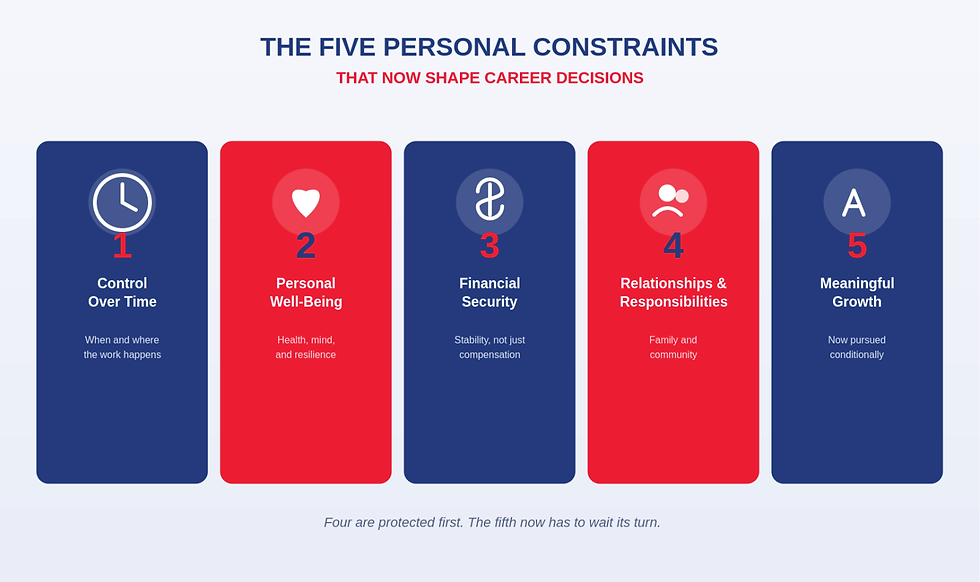
This realization became one of the most important findings in the entire research project because it challenged my original assumptions. I expected to discover that career development had been replaced by personal priorities. That is not what the evidence suggests. Instead, career development appears to have become conditional. Many professionals continue to desire challenging work, greater responsibility, and expanded capabilities. They simply prefer to pursue those objectives without significantly disrupting the broader life they have carefully constructed.
There is nothing inherently wrong with that aspiration. In fact, most of us would readily agree that success should improve our lives rather than diminish them. The concern arises only when these perfectly reasonable constraints become so restrictive that they eliminate the very opportunities most likely to produce extraordinary professional growth. Every meaningful career contains periods during which convenience temporarily gives way to learning, responsibility, and personal development. If we become unwilling to accept those temporary disruptions, we may unknowingly narrow the range of experiences that ultimately produce mastery.
This distinction reminds me of a principle that has surfaced repeatedly throughout my own career. Organizations rarely become exceptional by avoiding every uncomfortable decision. They improve because they consistently make thoughtful choices that create greater long-term capability, even when those choices require short-term sacrifice. I believe the same principle applies to individual careers. The professionals who ultimately become recognized experts, trusted advisors, respected executives, or influential leaders seldom arrive there because every position fit comfortably within their existing lifestyle. More often, they accepted opportunities that challenged them, stretched their thinking, demanded new skills, and occasionally disrupted their routines because they understood that temporary inconvenience is often the price of permanent capability.
Perhaps the most important conclusion from this portion of the research is not that today's professionals have become too protective of their personal lives. Such a conclusion would be both unfair and unsupported by the evidence. Rather, the research encourages a more thoughtful question. When an opportunity requires us to choose between preserving today's comfort and expanding tomorrow's capability, how do we decide? That single question may ultimately shape not only the next position we accept, but the professional we become over the course of an entire career.
When a Career Becomes a Collection of Employers
There was one comment I continued hearing throughout this research that bothered me more than almost any other. It appeared in conversations with professionals, in discussions about interviewing, and even in career advice offered by well-meaning mentors.
“That company will look good on your résumé.”
At first glance, there is nothing inherently wrong with that statement. Reputable organizations often provide outstanding training, expose employees to talented colleagues, and create opportunities that might not otherwise exist. There is genuine value in working for organizations known for operational excellence, innovation, or exceptional leadership. Experience gained in those environments can open doors throughout an individual's career.
The question is not whether a respected employer strengthens a résumé. Of course it can. The more interesting question is whether that has become the primary reason for accepting the position.
There is an important difference between saying, “I want to work there because I believe this organization will help me become an exceptional professional,” and saying, “I want to work there because having its name on my résumé will make it easier to leave later.”
The distinction may appear subtle, but I believe it represents two very different philosophies of career development. One views the organization as a place to build capability. The other views the organization as a credential to acquire.

Throughout this research, I searched for evidence that professionals were intentionally planning their next job before beginning the current one. Surprisingly, the research did not strongly support that conclusion. In fact, several recent studies suggest many younger professionals would actually prefer to remain with one employer if they believed that employer would continue providing new challenges, internal mobility, meaningful development, and opportunities to grow throughout their careers. In other words, the desire for movement may not be nearly as strong as the desire for continued development.
I found that distinction both encouraging and revealing.
Perhaps professionals are not collecting employers nearly as much as they are collecting opportunities to grow. When organizations fail to provide those opportunities internally, employees understandably begin looking elsewhere.
That shifts part of the responsibility back to employers. Organizations that expect loyalty while offering limited development should not be surprised when talented people leave. Likewise, organizations that invest heavily in learning, broaden responsibilities, encourage internal movement, and consistently challenge capable employees create reasons for talented professionals to remain. In many respects, the strongest retention strategy is not higher compensation. It is continued professional growth.
Yet there is another side to this discussion that deserves equal attention. Regardless of whether an individual changes employers every three years or remains with one organization for twenty, there is a danger that exists in either circumstance. It is entirely possible to accumulate impressive job titles without ever accumulating meaningful mastery.
I have occasionally met professionals whose résumés appeared extraordinary. They had worked for recognizable organizations, held increasingly impressive titles, and changed employers often enough to suggest consistent advancement. Yet after spending time with them, something became apparent. Their experience was broad, but not deep. They had participated in many initiatives but owned very few from beginning to end. They had inherited systems but seldom built them. They had joined organizations after strategies had already been established and departed before living with the long-term consequences of their own decisions.
That observation should not be interpreted as criticism. It is simply one possible outcome of excessive movement.
Professional judgment develops differently than technical knowledge. Knowledge can often be acquired in classrooms, books, seminars, or online courses. Judgment develops more slowly. It emerges when professionals make decisions whose consequences they cannot immediately escape. It develops when leaders must solve problems they did not create, improve systems they inherited, and remain accountable long enough to discover whether their decisions actually worked.
Some of the most capable executives I have known were not distinguished by extraordinary intelligence. They were distinguished by ownership. They remained with difficult problems until those problems were solved. They experienced success and failure in equal measure. They made decisions that occasionally proved incorrect, corrected them, and learned from the experience. They developed the kind of practical wisdom that simply cannot be acquired by moving from opportunity to opportunity before the results become visible.
This is one of the reasons I have always believed that professional capability compounds much like financial investments. Every meaningful assignment builds upon the lessons learned from previous assignments. Every difficult conversation improves future leadership. Every operational crisis strengthens future decision-making. Every strategic initiative, whether successful or unsuccessful, leaves behind experience that cannot easily be transferred through reading or observation alone.
When professionals leave organizations before completing those learning cycles, something valuable may be lost. They gain exposure to new environments, certainly, but they may also sacrifice the opportunity to develop deeper judgment that only comes from remaining accountable over time.
This does not mean changing employers is wrong. Some career moves are unquestionably wise. Organizations change. Leaders change. Opportunities emerge that significantly expand responsibility, accelerate learning, or provide experiences unavailable elsewhere. Throughout history, talented professionals have advanced their careers by accepting new challenges in new organizations.
The issue is not movement itself. The issue is movement without purpose. Changing employers because the next opportunity significantly expands capability is very different from changing employers simply because the next position appears more comfortable, slightly higher paying, or more convenient. One decision reflects intentional career development. The other may simply represent short-term optimization.
As I reflected on this distinction, I found myself asking another question. Imagine reviewing your career twenty years from now. Which accomplishment would make you prouder? That you worked for six impressive organizations?
Or that you became the kind of professional whose judgment, expertise, character, and capabilities were sought regardless of where you happened to work?
Those are not identical goals. One focuses primarily on where you have been. The other focuses on who you have become. The more I considered that difference, the more convinced I became that the most valuable asset any professional possesses is not the list of employers on a résumé. It is the capability that remains after every employer has been removed from the page.

Ultimately, organizations hire people for what they can do, not simply where they have worked. A distinguished employment history may open a door, but only genuine capability allows someone to continue walking through it. Mastery, judgment, credibility, and the ability to solve increasingly difficult problems remain the qualities that sustain exceptional careers long after the excitement of joining another new organization has faded.
Perhaps that is the better question for every professional to ask before accepting the next opportunity. Am I adding another employer to my résumé, or am I adding another chapter to my mastery?
Mastery Is Never an Accident
Throughout my career, I have often been asked why some professionals seem to accelerate while others, despite possessing similar intelligence, education, and technical ability, appear to plateau. It is a fascinating question because, over enough years, we all begin recognizing people who started from remarkably similar positions yet arrived at dramatically different destinations. Some become the individuals everyone seeks when the organization faces its most difficult challenges. Others remain competent contributors but never seem to develop the same level of influence, judgment, or confidence.

I no longer believe that difference can be explained primarily by intelligence. Nor do I believe it can be explained solely by education. Education is essential. Technical knowledge matters. Credentials matter. They open doors, establish credibility, and provide the foundation upon which careers are built. Yet after decades of observing professionals across manufacturing, mining, engineering, finance, operations, executive leadership, and consulting, I have reached a different conclusion. The greatest difference between exceptional professionals and average professionals is often found in the experiences they deliberately choose to pursue.
Mastery is rarely assigned. It is usually accepted. That distinction is easy to overlook because organizations naturally celebrate promotions, new titles, compensation increases, and visible accomplishments. Those milestones deserve recognition. They represent progress. Yet they often distract us from the quieter decisions that actually produced them. Long before someone becomes the respected executive, trusted engineer, accomplished controller, influential project manager, or sought-after consultant, they made dozens of decisions that were invisible to everyone else. They accepted the assignment no one else wanted. They volunteered to solve an operational problem that had frustrated others for years. They remained after the meeting ended to understand why a system was failing rather than simply reporting that it had failed. They became curious when others became comfortable.
Those decisions seldom receive immediate rewards. Over time, however, they compound. Compounding is a concept we normally associate with investing. Small gains accumulate, earning returns upon previous returns until the growth becomes almost exponential. Professional capability develops much the same way. Every difficult assignment teaches lessons that make the next difficult assignment easier to understand. Every complex decision strengthens future judgment. Every failure, if honestly examined, becomes preparation for future success. Over enough years, the difference between someone who consistently pursues those experiences and someone who consistently avoids them becomes extraordinary.
Research on expertise repeatedly arrives at similar conclusions. Whether studying accomplished physicians, elite athletes, musicians, military leaders, engineers, or executives, researchers consistently find that mastery develops through sustained exposure to progressively more demanding challenges. Expertise is not the product of isolated moments of brilliance. It is the accumulated result of deliberate effort repeated over long periods of time. The most accomplished professionals rarely become exceptional because they possessed unusual talent alone. They become exceptional because they repeatedly entered situations that required them to become more capable than they had previously been.
Looking back across my own career, I can identify assignments that I would gladly avoid if given the opportunity to relive them. Some involved organizations under significant financial pressure. Others required making decisions that affected people I respected and cared about. Some demanded learning technical disciplines I knew very little about. Others required accepting responsibility before I felt completely prepared.
None of those experiences were enjoyable while I was living them.
Every one of them became invaluable afterward. There is an old saying that experience is the best teacher. I have never believed that to be entirely accurate. Experience alone teaches very little. Many people repeat the same experiences for decades without becoming noticeably better. What develops mastery is thoughtful experience. It is the willingness to examine outcomes honestly, acknowledge mistakes without becoming defensive, seek better solutions, and intentionally apply those lessons the next time similar challenges appear.
That is one reason ownership is so important. Ownership forces reflection. When we remain accountable long enough to experience the consequences of our own decisions, learning becomes unavoidable. We discover which assumptions proved accurate and which did not. We begin distinguishing between decisions that merely sounded persuasive and decisions that actually produced meaningful results. Judgment develops because reality becomes our teacher rather than our opinions.
This may be one of the greatest hidden costs of approaching careers primarily as a sequence of employers rather than as a progression of mastery. If professionals leave before completing those learning cycles, they may accumulate impressive experiences without fully absorbing the lessons those experiences were capable of teaching. They gain variety but sacrifice depth. They become familiar with many organizations without necessarily becoming deeply proficient in solving increasingly difficult organizational problems.
I have often encouraged young professionals to think about their careers as though they were constructing a library rather than collecting souvenirs. Every significant assignment should add another volume to that library. Some books will teach technical knowledge. Others will teach leadership, negotiation, finance, operations, communication, or strategy. The objective is not simply to own more books than everyone else. The objective is to build a collection whose knowledge compounds over time until it becomes a resource that few others possess.
That perspective also changes the way we evaluate opportunities. Instead of asking whether the next position offers slightly better compensation or a more convenient schedule, we begin asking a different set of questions:
What will I learn here that I cannot easily learn elsewhere?
What responsibilities will I carry that I have never carried before?
What difficult problems will this opportunity require me to solve?
What capabilities will I possess five years from now because I accepted this challenge?
Those questions shift our attention away from the immediate transaction and toward the long-term investment. They recognize that careers, much like successful businesses, are built through the accumulation of assets. The most valuable asset we can accumulate is not another employer's name on a résumé. It is another layer of capability that permanently increases the value we bring to every future opportunity.
Perhaps that is the greatest lesson this research has reinforced for me. Professional mastery is not something organizations give us. They provide opportunities, resources, mentors, and experiences, but mastery remains a personal decision. It is built assignment by assignment, responsibility by responsibility, mistake by mistake, and lesson by lesson. Every professional eventually arrives at the career they have intentionally or unintentionally constructed through thousands of seemingly ordinary decisions.
When viewed from that perspective, the question facing every job seeker becomes remarkably clear. Am I choosing the opportunity that best protects the professional I am today? Or am I choosing the opportunity that will help me become the professional I hope to be tomorrow?

The answer to that question may determine far more than the next position. It may determine the entire trajectory of a career.
What Employers Are Experiencing and Why It Matters to Everyone
It would be easy to read everything we have discussed thus far and conclude that this article is primarily about employees. In reality, it is just as much about organizations. Careers do not develop in isolation. They develop within businesses that invest resources, assign responsibilities, create opportunities, and depend upon capable people to execute increasingly complex work. If the relationship between employer and employee changes, both sides experience the consequences.
During the past several years, organizations have found themselves navigating an increasingly difficult balance. They recognize that flexibility, employee well-being, meaningful work, and professional development have become important expectations within today's workforce. Many have responded by redesigning benefit programs, expanding remote work, investing in employee assistance programs, improving leadership training, and creating more flexible work arrangements. These efforts reflect a genuine attempt to respond to changing employee expectations, and in many organizations, they have produced meaningful improvements.
At the same time, employers continue facing a challenge that receives far less public attention. Developing exceptional professionals is expensive.
The investment extends far beyond wages and benefits. Organizations devote countless hours to mentoring, technical training, leadership development, project assignments, coaching, and gradually increasing responsibility. Experienced professionals spend years transferring knowledge that cannot be found in manuals or training courses. New employees make mistakes, learn from experienced colleagues, and slowly develop the judgment required to operate independently. Every organization that successfully develops people understands that capability is built through repeated investment over time.
That investment assumes something important. It assumes there will be enough time for both the individual and the organization to benefit from the development process.
If organizations increasingly believe talented employees will leave shortly after becoming fully productive, their willingness to make long-term developmental investments inevitably changes. Few executives consciously decide to reduce employee development, yet human nature and economic reality often produce exactly that outcome. Leaders become reluctant to assign their most promising projects to individuals they believe may not remain long enough to complete them. Significant leadership opportunities are delayed. Expensive developmental assignments become more selective. Informal mentoring relationships receive less attention because experienced leaders naturally invest where they believe the relationship will continue.
Most organizations would never describe these decisions as reduced commitment. They simply become more cautious. Ironically, employees often interpret that caution very differently. They begin feeling overlooked, conclude the organization is not investing in their future, and eventually seek opportunities elsewhere. The organization then points to turnover as justification for limiting future investment, while employees point to limited development as justification for leaving. Neither side intentionally created the problem, yet both become participants in a cycle that reinforces itself.

The research increasingly suggests that organizations achieving the strongest retention results are not necessarily those offering the highest compensation. They are the organizations that create visible pathways for continued growth. Employees who believe they are learning, expanding their responsibilities, and developing meaningful capabilities consistently report stronger engagement and greater commitment than employees who feel their professional development has stalled. In many respects, development has become one of the most powerful forms of retention.
That conclusion should encourage both employers and employees because it reveals common ground rather than conflict. Employees want to become more capable. Organizations need more capable employees. Those objectives are perfectly aligned. The challenge lies in creating enough mutual confidence for both sides to continue investing in one another.
There is another organizational consequence that deserves equal attention because it is rarely discussed outside executive leadership teams. Every organization depends upon institutional knowledge.
Processes improve because people remember why previous decisions succeeded or failed. Customer relationships deepen because trust develops over years rather than months. Operational excellence emerges because experienced professionals recognize subtle patterns that newer employees have not yet encountered. Strategic judgment improves because leaders have lived through multiple business cycles and understand how decisions made today will influence performance years later.
Institutional knowledge is one of the few competitive advantages that cannot be purchased quickly. It must be developed. When organizations experience continual turnover among experienced professionals, they lose far more than individual employees. They lose accumulated judgment, historical perspective, informal mentoring, technical expertise, and countless lessons learned through experience. New employees eventually replace those capabilities, but only after investing years developing similar understanding.
This observation brings us back to the central question of the article. Organizations need professionals who continue building mastery. Professionals need organizations willing to invest in that mastery. Neither objective can be fully achieved without the other.
Perhaps that is why I find the current conversation surrounding careers somewhat incomplete. Too often it is presented as though employers and employees possess fundamentally opposing interests. Employees seek flexibility while employers seek productivity. Employees desire personal fulfillment while employers pursue profitability. Employees value freedom while organizations value commitment.
I believe that framing misses something essential. The organizations that consistently outperform their competitors almost always employ highly capable professionals. Those professionals, in turn, generally built their capabilities because organizations trusted them with increasingly difficult work, provided opportunities to learn, challenged them to solve important problems, and remained willing to invest in their growth over many years.
Capability has always been the bridge connecting organizational success with individual success.
When organizations invest wisely in developing people, they become stronger organizations. When professionals intentionally pursue opportunities that expand their capabilities, they become stronger professionals. The relationship is not adversarial. It is mutually reinforcing.
Perhaps the most successful careers are not built by asking what employers owe employees or what employees owe employers. They are built when both recognize that developing extraordinary capability serves everyone's long-term interests. Organizations become more competitive. Professionals become more valuable. Customers receive better products and services. Communities benefit from stronger businesses. Everyone gains when mastery becomes the shared objective.
The more I considered that simple truth, the more convinced I became that the future belongs to organizations that deliberately develop people and to professionals who deliberately develop themselves. Neither side can fully succeed without the other.
The Career You Will Eventually Remember
When I began researching this article, I thought I was studying employment trends. I expected to learn more about changing workforce expectations, shifting priorities, and the relationship between employers and employees in a rapidly changing economy. Those subjects certainly deserve attention, and the research offered valuable insights into each of them. Yet somewhere along the way, the article quietly became about something much more important.
It became about the kind of professional each of us is ultimately trying to become.
Employment trends will continue to change. Artificial intelligence will reshape work in ways we cannot yet fully anticipate. Organizations will reorganize, industries will evolve, and technologies that seem revolutionary today will eventually become ordinary. Every generation experiences its own version of disruption and uncertainty. Those changes are inevitable. What has not changed, and I believe never will, is the extraordinary value of genuine professional capability.
As I reflected on more than four decades of building businesses, leading organizations, hiring people, mentoring professionals, and watching thousands of careers unfold, I realized that the individuals I admired most rarely shared a common educational background, personality, or career path. They came from different industries, possessed different talents, and solved very different kinds of problems. Yet they almost all shared one characteristic that became increasingly obvious the longer I knew them. They intentionally chose opportunities that demanded more of them than they believed they were capable of giving at the time.
They accepted assignments that others quietly avoided because failure seemed possible. They inherited operations that needed rebuilding rather than maintaining. They volunteered to solve difficult problems instead of waiting for easier ones to appear. They worked for demanding leaders who expected excellence rather than comfort. They accepted responsibility before they felt completely prepared, trusting that capability would grow to meet responsibility rather than waiting for confidence to arrive first.
Looking back, I doubt any of those experiences felt particularly rewarding while they were happening. Many were probably exhausting. Some were undoubtedly frustrating. A few almost certainly felt unfair. Yet those very experiences became the foundation of everything that followed. The confidence they eventually possessed was not something they discovered within themselves. It was something they earned by repeatedly doing difficult things well enough to become capable of doing even more difficult things the next time.
That realization caused me to think about a question I wish every young professional would ask before accepting the next position. It is not a question about compensation, flexibility, title, benefits, or even the organization itself. Those considerations all matter, and throughout this article I have intentionally acknowledged that they deserve thoughtful consideration. The question I wish more professionals would ask is much simpler and, I believe, much more important.
Who will I become if I accept this opportunity? Notice that the question is not, “What will I receive?” It is, “Who will I become?” Those two questions lead people toward very different careers because they evaluate opportunity through entirely different lenses. One primarily measures what the position offers today. The other considers what the experience will quietly build over the next five, ten, or twenty years.

When your career eventually comes to an end, very few people will remember the compensation you earned or how often you worked remotely. They probably will not remember your office, your title, or the impressive organizations listed on your résumé. Those accomplishments may have opened important doors, but they are not the things that define a professional life.
People remember something far more enduring. They remember the person who could be trusted when the decision was difficult. They remember the individual who remained calm while others became overwhelmed. They remember the leader who developed younger professionals instead of competing with them. They remember the engineer who solved problems no one else could solve, the financial professional whose judgment could be relied upon without hesitation, the operations leader who consistently improved every organization fortunate enough to have them, and the executive whose integrity remained unchanged regardless of the pressure surrounding the decision.
In the end, they remember capability expressed through character.
That is why I believe the most valuable investment any professional can make is not in another credential, another title, or another recognizable employer. Those things have value, but they are ultimately temporary. Capability endures. Sound judgment endures. Character endures. The ability to solve increasingly complex problems endures. Those qualities become part of who we are, and unlike a position or a paycheck, they remain with us regardless of where our careers eventually lead.
If there is one message I hope younger professionals carry away from this article, it is not that they should work longer hours or ignore the legitimate responsibilities that exist outside the workplace. I hope they protect their families, their health, their faith, their character, and the relationships that give life its deepest meaning. A successful career should strengthen those things, not replace them. My hope is simply that, while protecting what matters most, they never stop intentionally building themselves.

Accept the assignment that teaches you something you do not yet know. Volunteer for the responsibility that seems just beyond your current capability. Seek mentors who challenge your thinking rather than simply affirm your opinions. Build expertise patiently, knowing that genuine mastery compounds over decades rather than months. Above all, resist the temptation to allow temporary comfort to quietly determine the boundaries of your future.
One day, perhaps many years from now, someone beginning their own career will ask you for advice. They will not ask how comfortable your professional life was. They will ask how you became the person whose judgment they now respect. At that moment, your answer will not come from your résumé. It will come from the difficult decisions you accepted, the problems you chose to solve, the responsibilities you embraced, and the lessons you earned through experience. Those moments, accumulated over an entire career, become wisdom. That wisdom becomes leadership. Leadership, consistently practiced with integrity, becomes a legacy that continues influencing others long after your own career has ended.
Perhaps that is the real answer to the question posed by this article. The objective of a career is not to collect employers. The objective is to become the kind of professional whose capability, judgment, and character create opportunities wherever life may lead. Everything else is simply where you happened to work.
A Personal Invitation
If these ideas have caused you to pause and reconsider the direction of your own career, then I hope you will continue that conversation. Throughout my career, whether leading organizations, consulting with executive teams, or coaching individual professionals, I have found that sustainable success always begins in the same place. Build capability first. Performance follows. Build character alongside capability, and both become enduring competitive advantages that no economic cycle, technological disruption, or organizational restructuring can permanently diminish.
I invite you to visit www.thefitprofessional1.com to explore additional articles, resources, and consulting services designed to help individuals and organizations intentionally develop the capabilities that produce long-term success. My hope is that the ideas shared here encourage you not simply to find your next position, but to build a career that will still make you proud decades from now.
The opportunities you accept will eventually become the professional you become.
Choose them wisely.
Copyright © 2026 THEFITPROFESSIONAL1, LLC, owned by Paul Ayres.
Bibliography
Workforce and Employment Research
Deloitte. (2025). 2025 Gen Z and Millennial Survey. Deloitte Insights.
Deloitte. (2025). 2025 Global Human Capital Trends. Deloitte Insights.
Gallup. (2025). Top Reasons Employees Accept New Jobs. Gallup Workplace.
Gallup. (2025). Employee Attraction and Retention Indicators. Gallup Workplace.
LinkedIn Economic Graph. (2024–2025). Workforce Reports and Labor Market Research. LinkedIn Corporation.
McKinsey & Company. (2025). HR Monitor 2025. McKinsey & Company.
McKinsey & Company. (2024). The State of Organizations 2024. McKinsey & Company.
National Association of Colleges and Employers (NACE). (2024). Job Outlook 2024. Bethlehem, PA: NACE.
National Association of Colleges and Employers (NACE). (2025). Job Outlook 2025. Bethlehem, PA: NACE.
Pew Research Center. (2024–2025). Workforce, Employment, and Labor Market Studies.
PwC. (2024). Global Workforce Hopes and Fears Survey. PricewaterhouseCoopers.
Society for Human Resource Management (SHRM). (2024–2025). Workforce Trends and Talent Research Reports.
World Economic Forum. (2025). The Future of Jobs Report 2025. Geneva, Switzerland: World Economic Forum.
Management, Leadership, and Organizational Development
Boston Consulting Group. (2024–2025). Leadership, Talent, and Organizational Capability Publications.
Bain & Company. (2024–2025). Talent Management and Organizational Performance Research.
Christensen, C. M. (1997). The Innovator's Dilemma. Boston, MA: Harvard Business School Press.
Collins, J. (2001). Good to Great. New York, NY: HarperBusiness.
Drucker, P. F. (1999). Management Challenges for the 21st Century. New York, NY: HarperBusiness.
Harvard Business Review. (2024–2026). Articles addressing leadership development, employee retention, organizational capability, workforce trends, and career development.
Kahneman, D. (2011). Thinking, Fast and Slow. New York, NY: Farrar, Straus and Giroux.
Kellogg Insight. (2024–2026). Articles on leadership, organizational behavior, workforce trends, and career development. Northwestern University Kellogg School of Management.
Mintzberg, H. (2009). Managing. San Francisco, CA: Berrett-Koehler.
MIT Sloan Management Review. (2024–2026). Articles on leadership, organizational capability, artificial intelligence, and workforce development.
Porter, M. E. (1985). Competitive Advantage. New York, NY: Free Press.
Prahalad, C. K., & Hamel, G. (1990). “The Core Competence of the Corporation.” Harvard Business Review, 68(3), 79–91.
Schein, E. H. (2006). Career Anchors (3rd ed.). San Francisco, CA: Pfeiffer.
Expertise, Learning, and Professional Mastery
Ericsson, K. A., Charness, N., Feltovich, P. J., & Hoffman, R. R. (Eds.). (2006). The Cambridge Handbook of Expertise and Expert Performance. Cambridge University Press.
Ericsson, K. A., & Pool, R. (2016). Peak: Secrets from the New Science of Expertise. Boston, MA: Houghton Mifflin Harcourt.
Argote, L. (2013). Organizational Learning: Creating, Retaining and Transferring Knowledge (2nd ed.). Springer.
Senge, P. M. (2006). The Fifth Discipline: The Art and Practice of the Learning Organization (Revised Edition). New York, NY: Doubleday.
Career Development and Organizational Behavior
Arthur, M. B., Khapova, S. N., & Wilderom, C. P. M. (2005). “Career Success in a Boundaryless Career World.” Journal of Organizational Behavior, 26(2), 177–202.
Hall, D. T. (2004). “The Protean Career: A Quarter-Century Journey.” Journal of Vocational Behavior, 65(1), 1–13.
Rousseau, D. M. (1995). Psychological Contracts in Organizations. Thousand Oaks, CA: Sage Publications.
Recent career mobility and labor market analyses (2024–2026), including peer reviewed working papers examining job mobility, internal advancement, skill development, and career progression.
Author's Professional Publications and Working Papers
Ayres, P. (2026). Funding Your Future: Beyond Banks—Creative Alternatives to Funding Your Startup or Business Initiative.
Ayres, P. (2024–2026). THEFITPROFESSIONAL1 Newsletter. Professional articles on organizational leadership, execution, strategy, workforce capability, and business improvement.
Ayres, P. (2024–2026). Strategic Initiative Process (SIP) Working Papers.
Ayres, P. (2024–2026). SEGWAY Organizational Performance Framework Working Papers.
Ayres, P. (2024–2026). Executive Leadership, Organizational Capability, and Continuous Improvement Presentation Materials.
Additional Supporting Sources Consulted
Accenture. (2024–2025). Future Workforce and Talent Development Research.
EY. (2024–2025). Workforce and Leadership Studies.
Indeed Hiring Lab. (2024–2025). Labor Market and Hiring Trend Reports.
Korn Ferry. (2024–2025). Leadership, Succession, and Talent Development Research.
LinkedIn Learning. (2024–2025). Workplace Learning Reports.
U.S. Bureau of Labor Statistics. (2024–2025). Employment Situation Reports, Job Openings and Labor Turnover Survey (JOLTS), and related workforce statistics.


Comments